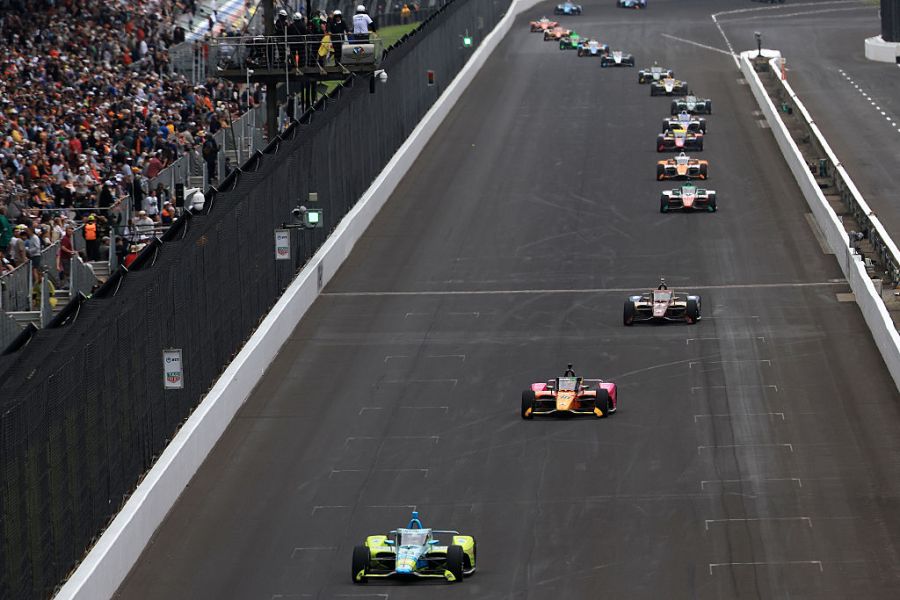

LOS ANGELES, Calif. — IndyCar on FOX is reaching new heights in its broadcasts. While fans are focused on the racing on track, drones are in a race of their own to capture all the action for viewers at home. For Beverly Hills Aerials, the sky is the limit, covering the IndyCar Series.
“It feels fantastic,” said Caleb des Cognets, the drone aerial director of photography for the company. “IndyCar is super fun. They’re very liberal with what they allow us to do around the cars.”
Beverly Hills Aerials has been working with FOX for five years, first covering the NASCAR Cup Series Daytona 500 in 2020.
“FOX called us and said, ‘Hey, can you guys build a drone that can go really, really fast next to cars?’ We said ‘Hell yeah,'” Des Cognets recalled with a smile.
Since then, their drone coverage has expanded to other major sporting events, including the Super Bowl, Major League Baseball and now, the NTT IndyCar Series.
“We add something totally different to the broadcast, and whenever we get to get taken live, it’s just such a cool shot,” said Alex Alvarado, a drone technician with Beverly Hills Aerials.
The team is covering ten of 17 races this season. The size of the team and its coverage depend on the size of the track and the crowd, ranging from a three-person crew manning a single drone for the Grand Prix of Long Beach to having multiple crews and drones for the Indianapolis 500.
The team is made up of a camera operator, drone pilot, and technician. The camera operator uses a remote control to zoom, tilt, pan, and roll. For smaller shoots, the drone pilot flies the drone and operates the camera, while Des Cognets establishes the camera angles. The technician keeps a lookout for any obstacles and safety concerns, maintains the drone equipment, replaces batteries, and ensures the drone is transmitting a good feed to the broadcast crew.
“We have the best people operating the sticks, so we know what we’re doing, and we make it look good on TV,” said drone pilot Stephen Szot.
The drone team goes through an extensive amount of training, with experience in cinematography, broadcasting, and aviation. Szot even has a helicopter license. The FAA permits them to fly in certain areas with approval from IndyCar. Once in the air, the team works with the television director on the camera angles.
“He kind of gives us a general area to fly in or a subject, and then we design the shots in real time. It’s a lot of fun. It’s got a lot of challenges,” said Des Cognets.
Some of those challenges are exactly what fans love about the sport.
“The noise here is like the next level,” said Alvarado. “So, as well as our operators communicating with the director, he’s communicating to us on the drone team, so making sure we’re staying in constant communication with these loud engines, as well as safety is always a concern.”
And then there’s the speed…
“The ovals are harder because they stay faster the whole time. It’s a bit easier to predict where they’re coming, but we have a lot more fun on the street courses and the road courses where there’s moving turns, and we can have the cars get closer to us,” Szot explained.
With each takeoff, the team gains a new perspective on IndyCar.
“I was never a huge fan of racing growing up, so getting to experience this has been a whole new world for me, and I’ve been very excited to be part of it,” said Alvarado
“Every year, it just gets better and more fun,” said Des Cognets
With the opportunity to cover some of the biggest races in motorsports and the largest single-day sporting event in the world, Szot summed up how much it means to the team.
“It’s an honor.”

Comments are closed.